Marketing & Communication
Campaign Overview
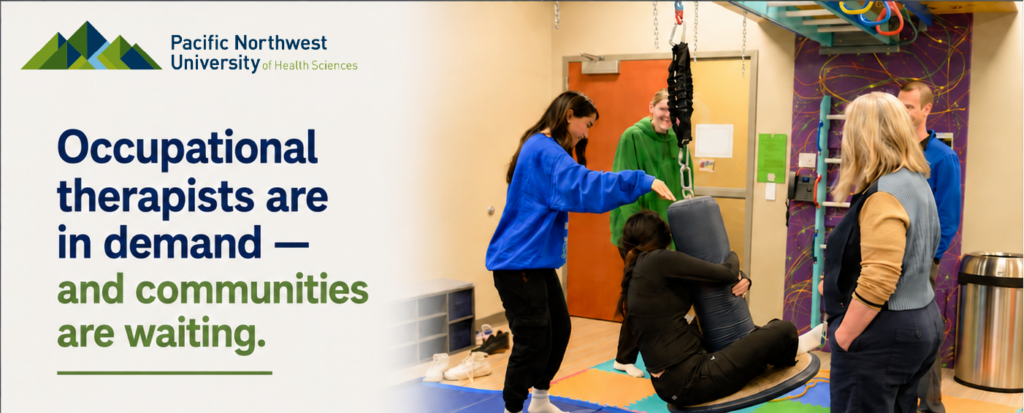
The goal of this campaign is to increase public awareness of Occupational Therapy (OT) as a meaningful, in-demand healthcare career while driving increased engagement with PNWU’s Master of Science in Occupational Therapy (MSOT) program. Paid social media advertising will be used to highlight the value of OT, promote the benefits of PNWU’s program, and encourage prospective students to register for an information session. This campaign will run continuously for 3–6 months with recurring optimizations based on performance.
Campaign Goals
Primary Goals
- Increase awareness of OT as a career path among prospective students across the Pacific Northwest and targeted expansion regions.
- Increase MSOT information session registrations from the current average of 5–14 per month to a new goal of 20 registrations per month.
Secondary Goals
- Increase traffic to the MSOT web pages on pnwu.edu.
- Increase engagement with OT-related content on PNWU’s social channels.
Key Performance Indicators (KPIs)
Engagement + Traffic Metrics
- Clicks on ads
- Click-through rate (CTR)
- Time spent on the MSOT landing page (session duration)
- Bounce rate
Conversion Metrics
- Primary conversions: information session registrations
- Secondary conversions: inquiry form completions
Cost Efficiency Metrics
- Cost per click (CPC)
- Cost per registration (CPR)
Campaign Messaging Strategy
Core Messaging Theme: “Become the creative, compassionate healthcare professional people need, and start your OT career in just two years.”
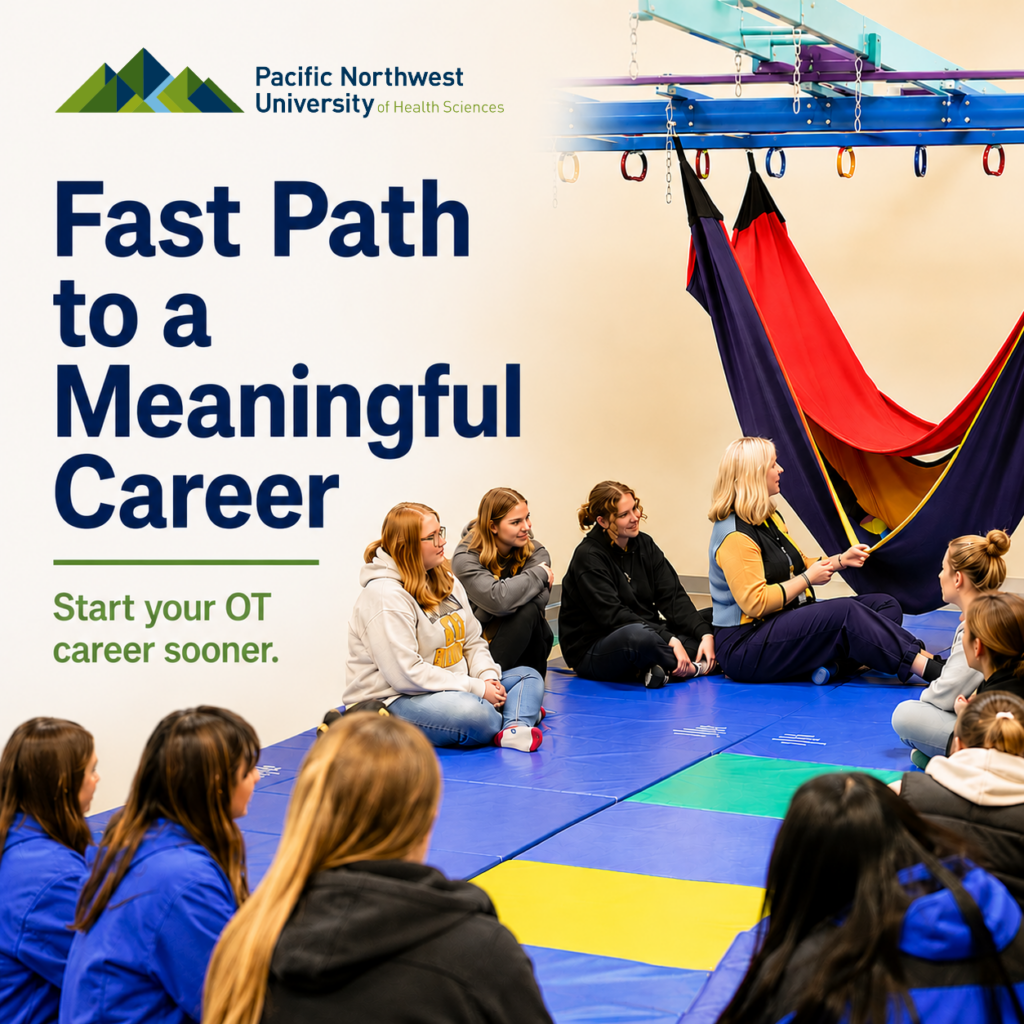
Key Message Pillars
- A Fast Path to a Meaningful Career
- Two-year master’s program
- Begin practicing quickly
- Hands-on learning and fieldwork (PNWU OT students have access to select from over 1,400 fieldwork sites nationwide.)
- Economic advantage (Helps people “learn and earn” on a more efficient timeline.)
- OT is an In-Demand Healthcare Profession
- High-growth job outlook
- Variety of settings: hospitals, schools, mental health, rehab, home health, and more
- Increasing need for providers in rural and underserved areas
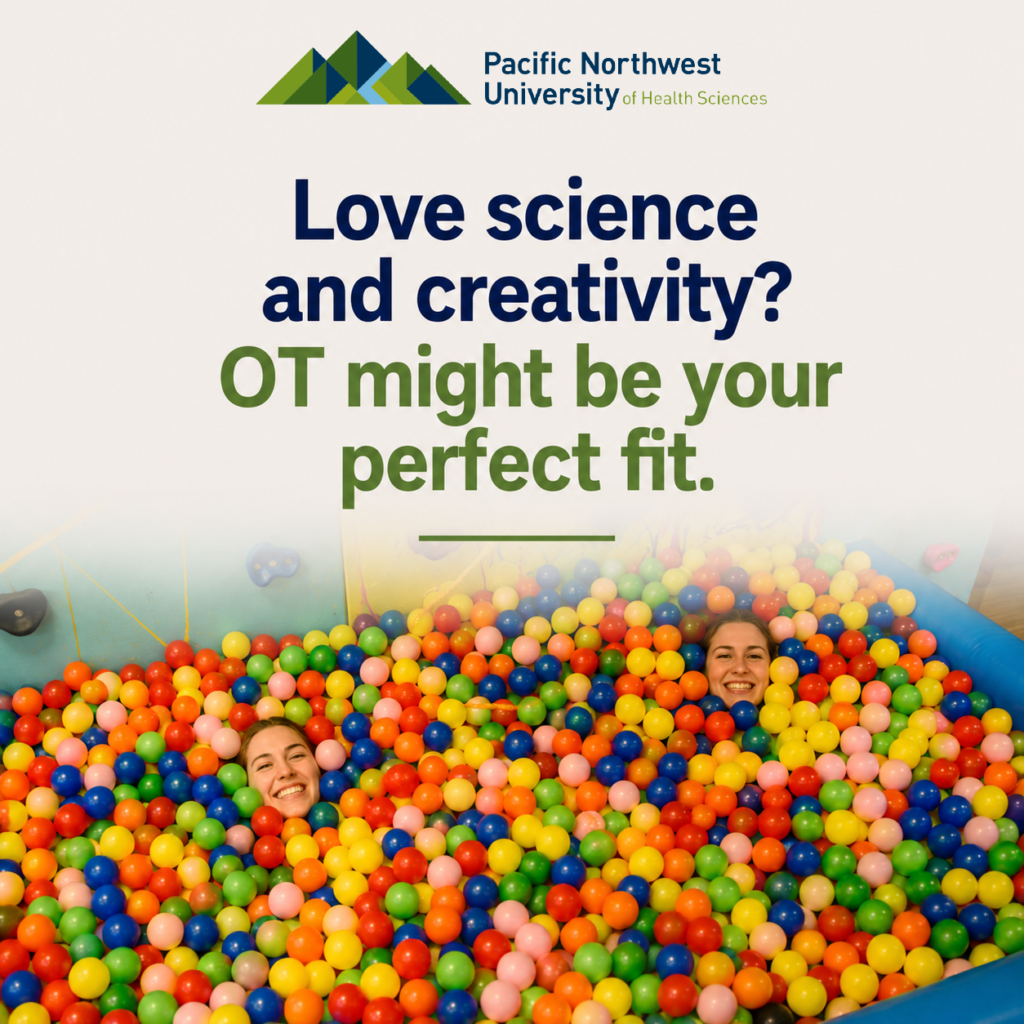
- Perfect for People Who Love Creative Problem Solving
- Every client presents a unique challenge
- Work involves adapting environments, designing interventions, and improving life
- Ideal for individuals who like both science and creativity
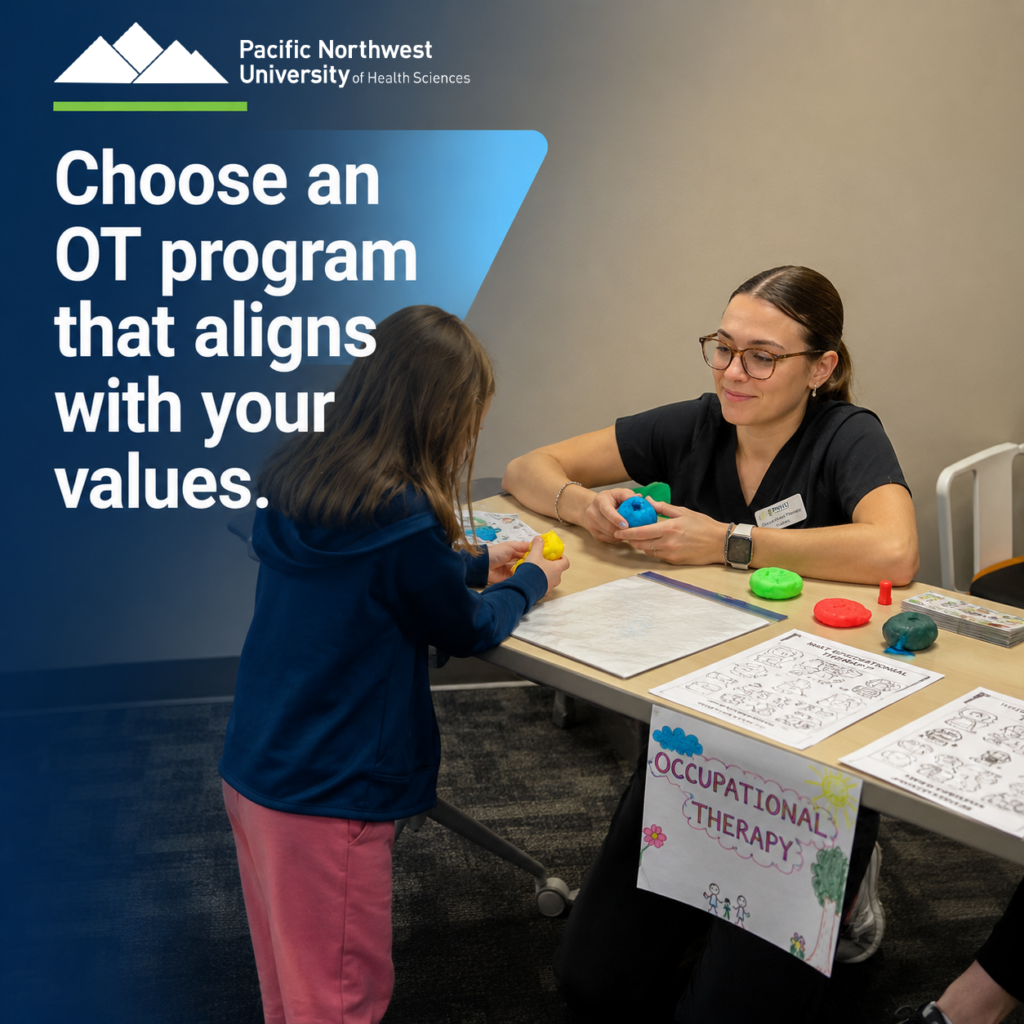
- Inclusive Admissions, Flexible Pathways
- Welcoming applicants from a variety of academic and professional backgrounds
- Full-time and part-time tracks to support different lifestyles
- Strong support system and student-centered learning environment
- Why PNWU
- Mission-driven education focused on whole-person care
- Strong ties to rural and medically underserved communities
- Faculty dedicated to mentorship and student success
Audience Strategy
Primary Audience (Meta Custom Audiences)
- Individuals who have visited OT-related pages on pnwu.edu
- Meta users who have interacted with OT content or ads previously
- Lookalike audiences based on past info session registrants
Secondary Audience Recommendations
- People interested in related healthcare careers, including:
- Physician Assistant (PA)
- Nursing
- Speech-Language Pathology
- Rehabilitation sciences
- Students who follow or show interest in:
- Community colleges
- Science programs
- Health careers exploration pages
Demographics & Locations
Core regions
- Eastern Washington
- Eastern Oregon
- Northern Idaho
Expansion test regions (rural and underserved focus):
- Wyoming
- Arizona
- Utah
These regions align with PNWU’s mission and show promising OT workforce needs.
A/B Testing Strategy
A/B testing to refine and optimize:
1. Ad Creative
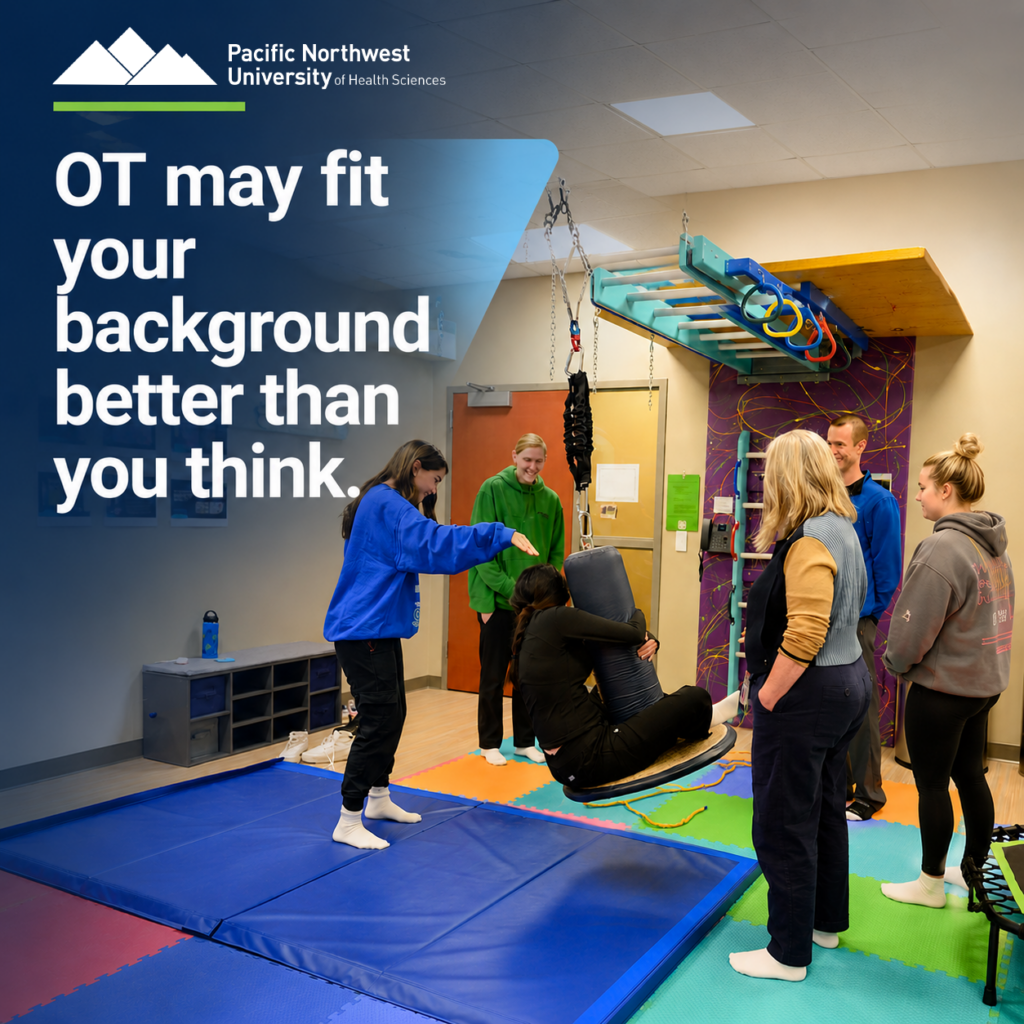
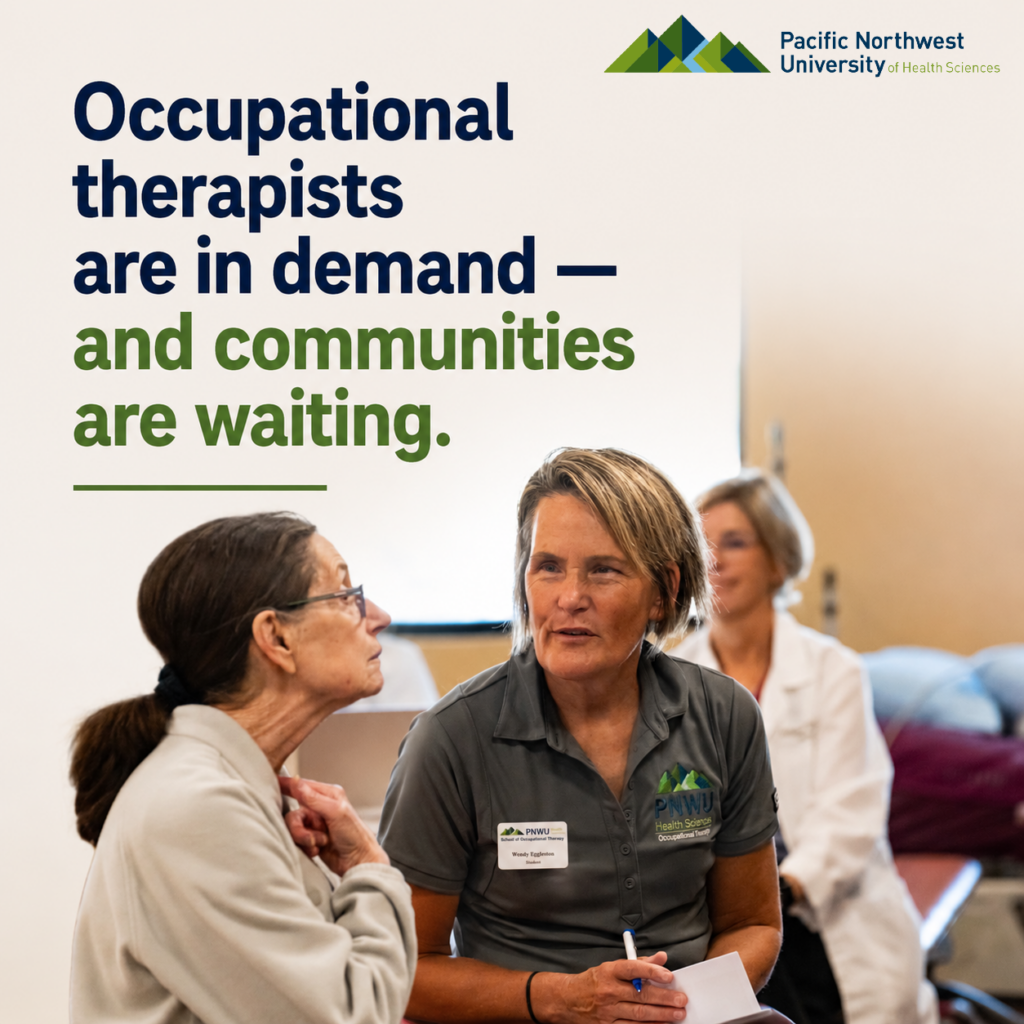
- Version A: Human-centered storytelling (students, patient interactions, fieldwork images)
- Version B: Program-focused messaging (timeline, career stats, admissions pathway)
2. Messaging / Value Proposition
- A: “Start your OT career in two years.”
- B: “In-demand healthcare career with flexibility and creativity.”
3. Audience Expansion Tests
- Test rural cities in WY, AZ, UT
- Compare performance vs. established Pacific Northwest regions
- Evaluate: cost per click, CTR, conversion rate, cost per registration
Testing Timeline
- Run tests for 2–4 weeks
- Keep top-performing ads, retire underperforming versions
- Rotate in fresh creative every 6–8 weeks
Reporting Structure
A clear reporting system ensured stakeholders were aligned. Reports were shared monthly (and quarterly for trends). The MarCom team reviewed these reports in their monthly strategy sessions.
Monthly Report Includes:
- Overall campaign summary
- Spend breakdown
- KPIs (clicks, CTR, CPC, registration conversions)
- Top-performing ads + audiences
- Insights and recommendations for next month
Audience:
- Enrollment Team
- OT Program Dean
- University President
- MarCom Team
Campaign Timeline
Month 1: Launch campaign, and then run initial A/B tests
Month 2: Optimize based on results, and then scale best-performing regions and messages
Month 3: Expand targeting, refresh creative, and drive final conversion push
Campaign Summary
This campaign leveraged thoughtful messaging, targeted ad placements, intentional audience development, and a robust measurement framework to increase awareness of OT and drive registrations for MSOT information sessions. Rather than simply saying “Apply Now,” we wanted to tell stories that help prospective students picture themselves as occupational therapists and understand the impact they could have on patients’ lives.
The campaign focused on answering questions like:
- “Could OT be the right career for me?”
- “Can I make a difference?”
- “Is there a program that fits my life?”
- “What does an OT actually do?”
That narrative approach was intended to generate more engagement than purely informational ads.
Campaign Period
January – March, 2026
Primary Goal
Increase awareness of PNWU’s MSOT program and drive registrations for monthly information sessions.
Campaign Objectives
| Goal | Status |
|---|---|
| Increase program awareness |  Exceeded Exceeded |
| Increase website traffic | Exceeded |
| Increase Information Session registrations | Exceeded |
| Improve audience engagement | Exceeded |
Executive Summary
The Occupational Therapy social media campaign exceeded its primary objectives by increasing awareness of the program while significantly improving prospective student engagement.
Compared to the three months prior to the campaign, information session registrations increased by 94%, website engagement improved across every key metric, and paid social ads generated a strong click-through rate well above higher education industry averages.
Overall, the campaign successfully introduced the MSOT program to new audiences while moving prospective students further down the enrollment funnel.
Campaign Overview
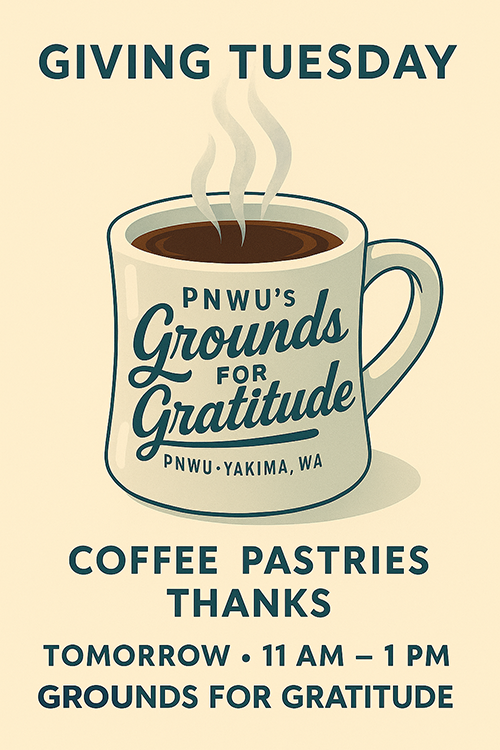
To build excitement for Giving Tuesday 2026 and encourage authentic student participation, the Marketing Communications team launched Grounds for Gratitude, a campus engagement event at PNWU. Students were invited to stop by for complimentary coffee and pastries while sharing what they were grateful for and how PNWU had impacted their educational journey.
The event created a relaxed, welcoming atmosphere that made it easy for students to participate in on-camera interviews. The videos collected during the event became the foundation of the Giving Tuesday campaign, highlighting genuine student voices and demonstrating the impact of donor support on the PNWU community.
To promote attendance, the team designed and distributed a themed digital flyer via email, featuring the event branding, time, and location. By pairing a simple incentive with meaningful storytelling, Grounds for Gratitude successfully generated engaging content while strengthening connections with students and reinforcing the spirit of gratitude that defined the Giving Tuesday campaign.
Campaign Goals
The Grounds for Gratitude campaign was designed to support PNWU’s Giving Tuesday initiative by creating authentic, donor-centered content while increasing student engagement. This was an idea that manifested from the need to prepare earlier for Giving Tuesday based on historical lessons learned.
The primary goals included:
- Capture authentic student stories that expressed gratitude for donor support and highlighted the impact of philanthropy on the student experience.
- Develop compelling Giving Tuesday content for use across social media, email, and donor communications.
- Increase student participation in Advancement and Marketing initiatives through a fun, low-pressure campus event.
- Strengthen the connection between donors and students by giving donors the opportunity to hear directly from those their generosity supports.
- Promote a culture of gratitude across campus by encouraging students to reflect on and share their appreciation.
- Increase awareness of Giving Tuesday within the PNWU community and build momentum for the university’s annual fundraising efforts.
Executive Summary
The Marketing Communications team successfully executed Grounds for Gratitude, a campus engagement event designed to generate authentic student content for PNWU’s Giving Tuesday campaign. Students were invited to enjoy complimentary coffee and pastries while recording short video messages expressing their gratitude to the donors whose generosity helps make their education possible.
The event exceeded expectations, with more than 15 students participating in on-camera interviews over the two-hour event. The relaxed atmosphere and simple incentive encouraged enthusiastic participation and resulted in a diverse collection of heartfelt testimonials that reflected the impact of donor support across the student body.
Following the event, the Marketing Communications team produced a polished Giving Tuesday video featuring these student messages. The final video was shared across PNWU’s social media channels and incorporated into donor communications, providing an authentic and emotionally compelling expression of gratitude that reinforced the value of philanthropic giving.
We raised over $65,000 in our Giving Tuesday 2025 campaign. One large donor told our leadership team that watching our videos sent via email really made them want to give more. They donated an additional $12,000.
Key Takeaways
Overall, Grounds for Gratitude successfully met its objectives by engaging students, creating high-quality campaign assets, and strengthening the connection between donors and the students they support. The campaign demonstrated how a simple, well-executed campus event can produce meaningful storytelling while fostering a culture of appreciation and generosity within the PNWU community. It also proved in the power of free coffee and pastries to tired medical school students.
Campaign Summary
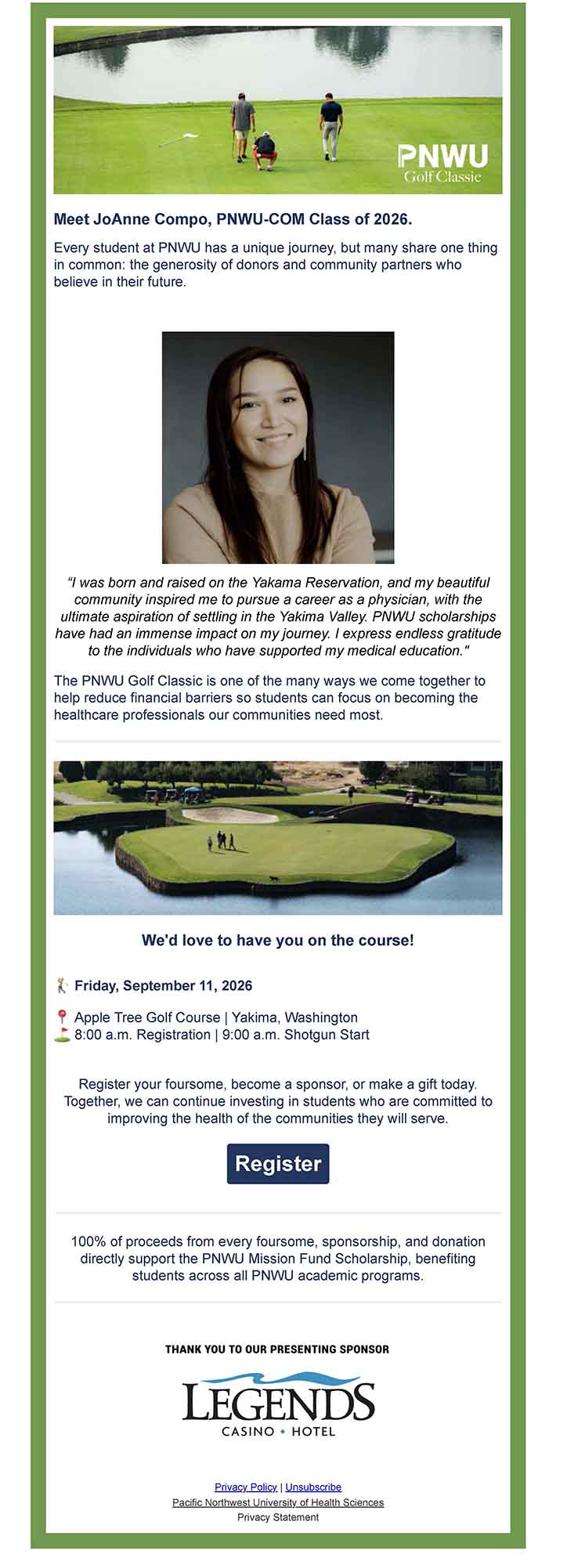
The PNWU Golf Classic 2026 Email Campaign reimagined traditional event marketing by shifting the focus from event logistics to the impact of philanthropy. Rather than relying on a standard sequence of “Save the Date,” invitation, and registration reminder emails, I developed a stewardship-driven storytelling strategy that centered on the students whose lives are transformed through scholarship support generated by the Golf Classic.
Each email highlighted the story of a PNWU student pursuing a career in medicine, dentistry, occupational therapy, or physical therapy, illustrating how donor generosity directly supports future healthcare professionals. By connecting prospective golfers and sponsors with the people behind the mission, the campaign reinforced that participation in the Golf Classic is more than attending a fundraising event—it is an investment in the next generation of healthcare providers serving communities throughout the Pacific Northwest.
This narrative-first approach created a stronger emotional connection with recipients while aligning the campaign with the university’s mission and values. The storytelling strategy also produced measurable results: email-driven registrations increased from an average of two registrations per email to approximately nine registrations per email, demonstrating that mission-focused communications significantly outperformed traditional event promotion.
Subject lines were also updated according to the new storytelling approach.
ORIGINAL EMAIL SUBJECT: “Reminder: Register today for the PNWU Golf Classic!”
UPDATED STORYTELLING SUBJECT: “A Great Day of Golf. An Even Greater Cause.”
The campaign serves as an example of how stewardship, authentic storytelling, and strategic content can improve engagement while advancing fundraising goals. Rather than simply asking supporters to register, the emails invited them to become part of a larger story—one in which their participation helps educate future physicians and healthcare professionals who will make a lasting impact in their communities.
Campaign Goals
- Increase registrations for the 2026 PNWU Golf Classic through a strategic email campaign.
- Shift from transactional event promotion to mission-driven storytelling.
- Demonstrate the tangible impact of Golf Classic proceeds by highlighting scholarship recipients and student success stories.
- Strengthen donor stewardship by connecting supporters with the students who benefit from their generosity.
- Reinforce PNWU’s mission of educating future healthcare professionals.
- Improve email engagement and conversion rates through authentic, people-centered content.
Executive Summary
The PNWU Golf Classic 2026 Email Campaign transformed a traditional event registration campaign into a mission-focused storytelling initiative. By replacing generic promotional messaging with authentic student stories, the campaign connected golfers, sponsors, and donors to the real impact of their participation.
Featuring scholarship recipients and students preparing for careers in medicine, dentistry, occupational therapy, and physical therapy, the email series emphasized that every registration helps educate the next generation of healthcare providers. This stewardship-first approach resonated with audiences and significantly increased engagement.
Key Takeaways
The results were substantial: registrations attributed to each email increased from an average of two to approximately nine, representing more than a fourfold improvement in conversion performance. Beyond stronger registration numbers, the campaign elevated the Golf Classic from a fundraising event to a compelling opportunity for supporters to invest in students and the future of healthcare.
This project demonstrates the power of strategic storytelling as fundraising to strengthen donor relationships, improve campaign performance, and communicate the lasting impact of philanthropy.
Web Pages Built for PNWU:
Hispanic Heritage Month Celebration
Each of these web pages further demonstrate the power of strategic storytelling as engagement. Previous web pages were text-heavy, and difficult to navigate. These three web pages garnered significant more traffic than pages for the same topics in years past.
Community Engagement
Community Engagement Project Summary
When La Salle High School invited Pacific Northwest University of Health Sciences (PNWU) to participate in its annual STEM Fair, the request came with only a few days’ notice. Recognizing the opportunity to strengthen PNWU’s presence in the community and inspire future healthcare professionals, I took the initiative to coordinate the university’s participation.
Working across departments, I reached out during our weekly social media marketing meeting to identify available faculty and student volunteers. Within a matter of days, I successfully recruited physicians from the School of Osteopathic Medicine and three medical students to represent PNWU at the event.
To create an engaging, hands-on experience, I organized an interactive booth where students and families could make custom anatomy-themed buttons featuring illustrations of the heart, lungs, brain, and the Anato-Bee program logo. The activity provided a fun introduction to human anatomy while creating opportunities for meaningful conversations about careers in healthcare and educational pathways at PNWU.
The event was a tremendous success. Our team engaged with more than 55 students throughout the day, fostering curiosity about medicine and the health sciences. Most importantly, four students expressed interest in the Anato-Bee program and signed up to learn more, creating new opportunities for continued outreach and engagement.
This project demonstrated the value of proactive collaboration, strategic community engagement, and creative event planning. By mobilizing faculty, students, and marketing resources on short notice, PNWU was able to make a meaningful impact at a local STEM event while strengthening relationships with area schools and inspiring the next generation of healthcare professionals.
Project Goals
- Strengthen PNWU’s relationships with local schools and community partners.
- Increase awareness of healthcare careers and educational opportunities at PNWU.
- Promote the Anato-Bee outreach program to prospective high school participants.
- Create an interactive, memorable experience that encouraged STEM exploration.
- Coordinate cross-campus collaboration among faculty, students, and Marketing Communications.
- Inspire young students to consider careers in medicine and the health sciences.
Executive Summary
The La Salle High School STEM Fair project showcased PNWU’s commitment to community engagement through education and outreach. Despite receiving the invitation only days before the event, I coordinated participation by recruiting physicians from the School of Osteopathic Medicine, three medical students, and developing an interactive anatomy-themed activity that appealed to students and families alike.
The event attracted strong participation, with more than 55 students engaging with the PNWU booth. Through hands-on activities and conversations with faculty and medical students, attendees learned about anatomy, healthcare careers, and opportunities available through PNWU. The outreach also generated measurable results, with four students signing up to receive more information about the Anato-Bee program.
Key Takeaways
This project highlights my ability to build partnerships, coordinate cross-functional teams under tight deadlines, and create engaging community experiences that advance both educational outreach and the university’s mission. It taught me to trust my instinct a bit more when I feel there is a connection with people whose values align to mine. It also sheds light on the power of community and mission-driven individuals. My colleagues at PNWU from the School of Osteopathic Medicine are so incredibly mission-driven that they immediately volunteered to represent the university on a Saturday morning with only a four-day notice. Never underestimate the impact a few dedicated individuals!
Project Overview
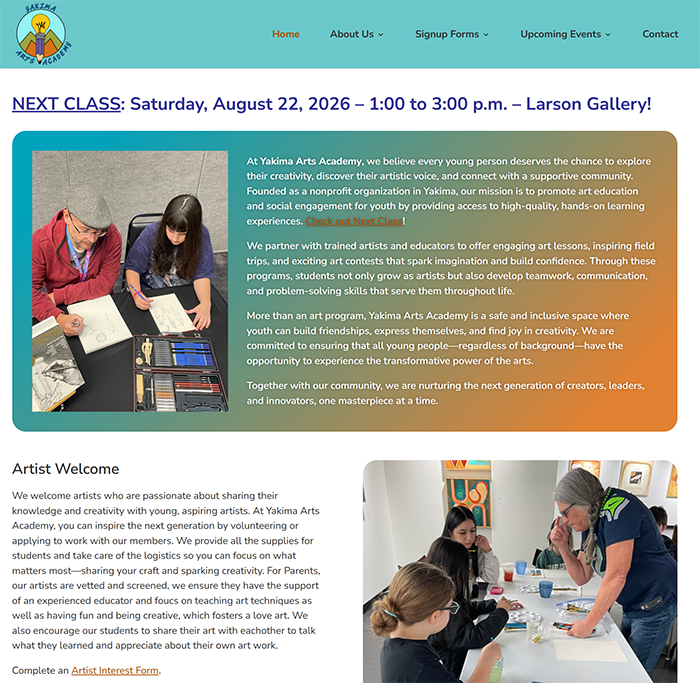
The Yakima Arts Academy (YAA) is undertaking a comprehensive rebranding and website redesign to better reflect its mission of inspiring creativity, fostering artistic excellence, and serving the Yakima Valley community. As a member of the Board of Directors, I am leading the strategic direction of this initiative to modernize the organization’s visual identity, improve its digital presence, and create a stronger connection with students, families, donors, and community partners.
The project will result in a refreshed brand identity, updated messaging, and a redesigned website that improves usability, increases enrollment inquiries, supports fundraising efforts, and showcases the impact of YAA’s programs.
Project Objectives
Brand Strategy
- Modernize the Yakima Arts Academy brand while honoring its mission.
- Develop a cohesive visual identity that reflects creativity, accessibility, and excellence.
- Establish consistent branding across digital and print communications.
Website Redesign
- Create an intuitive, mobile-friendly website.
- Improve navigation and user experience.
- Make it easier for families to learn about programs and register.
- Increase visibility of performances, events, and student achievements.
- Improve donor and sponsor engagement.
Community Engagement
- Better communicate YAA’s impact in the Yakima community.
- Showcase student success stories.
- Highlight faculty and alumni.
- Increase awareness of scholarship opportunities.
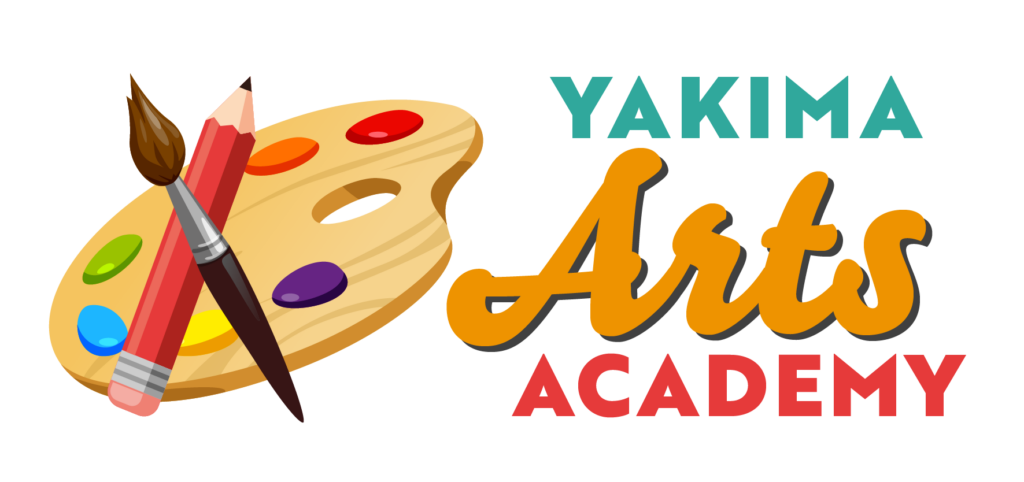
Yakima Arts Academy — Modern Logo
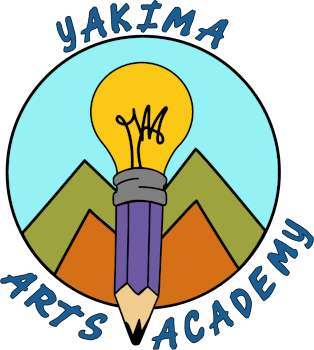
Concept 1 — “Creative Spark” (Primary Recommendation)
Design Direction
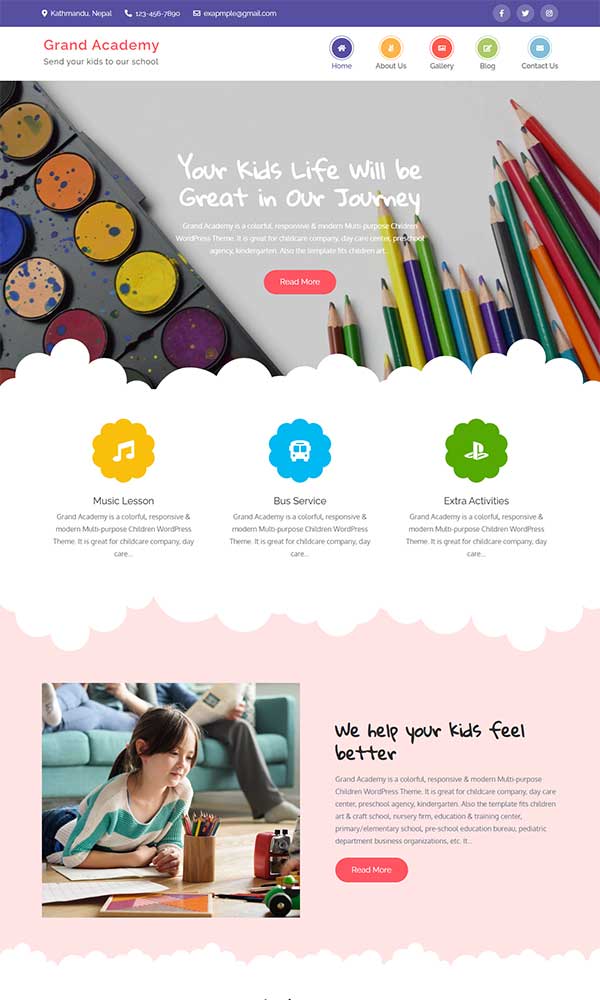
- Bright multi-color paint burst or brush strokes
- Clean modern typography
- Youth-friendly but still professional
- Flexible for social media, shirts, banners, stickers
Visual Elements
- Color splash / brush stroke
- Pencil or paintbrush icon
- Bright friendly palette (teal, coral, yellow, purple)
Color Palette
- Teal — Creativity & growth
- Coral — Energy & youth
- Golden Yellow — Imagination
- Purple — Artistic expression
Typography
- Rounded modern sans-serif (friendly + readable)
- Optional script accent for “Arts”
Scope of Work
Phase 1 – Discovery & Research
Stakeholder Interviews
Meet with:
- Board members
- Executive Director
- Faculty
- Parents
- Students
- Community partners
Brand Audit
Evaluate:
- Current logo
- Color palette
- Typography
- Website
- Social media
- Marketing materials
Competitive Research
Review comparable organizations including:
- Arts academies
- Community arts organizations
- Youth music and dance programs
- Performing arts schools
Deliverables:
- Brand Audit Report
- SWOT Analysis
- Audience Personas
Phase 2 – Brand Development
Brand Positioning
Develop:
- Mission refinement
- Vision statement
- Core values
- Brand personality
- Key messaging
Visual Identity
Create:
- Updated logo
- Color palette
- Typography system
- Graphic elements
- Photography style
- Brand guidelines
Deliverables:
- Brand Style Guide
Phase 3 – Website Strategy
Information Architecture
Develop website structure:
- Home
- About
- Programs
- Faculty
- Events
- Performances
- Scholarships
- Support YAA
- News
- Contact
Content Strategy
Develop content that emphasizes:
- Student stories
- Family testimonials
- Faculty spotlights
- Community partnerships
- Alumni success
- Upcoming events
Deliverables:
- Website Sitemap
- Content Outline
Phase 4 – Website Design
Design:
- Homepage
- Interior page templates
- Mobile layouts
- Calls to action
- Donation pages
- Registration pages
Focus Areas:
- Accessibility
- Responsive design
- Easy navigation
- Visual storytelling
- Performance optimization
Deliverables:
- Wireframes
- High-fidelity mockups
- Design system
Phase 5 – Development
Content Development
Copywriting
- Homepage
- Program descriptions
- Faculty bios
- Event pages
- About page
- Donor messaging
Photography
Capture:
- Dance
- Music
- Theater
- Student performances
- Rehearsals
- Community events
Video
Produce:
- Highlight Reels
- Student testimonials
- Parent testimonials
- Instructor introductions
Website Development
Implement:
- Responsive website
- SEO optimization
- Event calendar
- Contact forms
- Donation integration
- Newsletter signup
- Social media integration
Testing:
- Accessibility
- Mobile compatibility
- Browser testing
- Page speed
- User testing
Phase 6 – Launch
Launch Plan
- Press release
- Final review
- Board approval
- Website launch
- Social media announcement
- Email announcement
Key Deliverables
- Brand Audit
- Audience Personas
- Messaging Framework
- Brand Style Guide
- Website Sitemap
- Wireframes
- Website Design
- Website Copy
- Photography Library
- Video Assets
- Responsive Website
- Launch Plan
Success Metrics
Branding
- Consistent use of new visual identity across all platforms.
- Positive feedback from board members, families, and community stakeholders.
- Increased recognition of the Yakima Arts Academy brand.
Website
- Increase website traffic.
- Increase average time on site.
- Improve mobile usability.
- Increase online inquiries and registrations.
- Increase newsletter subscriptions.
- Increase online donations.
Community Engagement
- Growth in donor engagement and sponsorship opportunities.
- Increased attendance at performances and events.
- Growth in student enrollment.
- More inquiries about scholarships.
- Increased volunteer participation.
Executive Summary
The Yakima Arts Academy Rebranding and Website Redesign project is a strategic initiative to strengthen the organization’s identity and expand its impact within the Yakima Valley. By developing a refreshed brand and a modern, user-centered website, the project aims to better communicate YAA’s mission, celebrate student achievement, and make it easier for families, donors, and community members to engage with the organization.
The strategy prioritizes storytelling over simple promotion, highlighting the experiences of students, faculty, and alumni to demonstrate the transformative power of arts education. Combined with improved navigation, accessibility, and mobile responsiveness, the redesigned website will serve as a central hub for program information, event promotion, registration, and philanthropic support.
Ultimately, this initiative will position Yakima Arts Academy for long-term growth by creating a cohesive, engaging brand experience that reflects the organization’s creativity, excellence, and commitment to enriching the community through the arts.
Project Summary
As the U.S. Lead for Digital River’s Global Diversity, Equity & Inclusion (DEI) Council, I collaborated with regional DEI leaders across the United States, United Kingdom, and Taiwan to develop initiatives that fostered inclusion, professional development, and cross-cultural collaboration throughout the organization.
One of the council’s flagship initiatives was a two-year mentorship partnership with female students at Maynooth University in Ireland, designed to encourage and support women pursuing careers in technology. Working alongside female executives and leaders from across Digital River, we created a structured mentoring program that connected students with experienced professionals who shared insights on career development, leadership, navigating the technology industry, and building confidence as women entering STEM fields.
The mentorship program included monthly virtual sessions focused on topics such as:
- Career planning
- Leadership development
- Workplace inclusion
- Personal branding
- Networking
- Overcoming challenges commonly experienced by women in technology
The program also provided students with opportunities to build meaningful relationships with mentors from diverse backgrounds and global business functions.
Following a successful inaugural year, the program expanded significantly during its second year. Additional mentors joined the initiative, participation increased, and the curriculum broadened to include a wider range of professional development topics and leadership perspectives. The program became a model for global collaboration within the DEI Council and strengthened Digital River’s commitment to investing in future talent.
Serving as the U.S. lead required coordinating across international teams, aligning stakeholders, supporting program planning, and fostering engagement among executives, mentors, and students. The experience reinforced the value of mentorship as a tool for creating opportunity, building confidence, and cultivating a more inclusive technology workforce.
Project Goals
- Support and empower women pursuing careers in technology through mentorship and professional development.
- Build meaningful connections between university students and experienced women leaders at Digital River.
- Strengthen Digital River’s global DEI initiatives through cross-regional collaboration.
- Provide students with practical guidance on leadership, career planning, networking, and navigating the technology industry.
- Increase engagement among female executives and leaders by creating opportunities to mentor and inspire future professionals.
- Expand the program’s reach and impact through continuous improvement and growth over multiple years.
Executive Summary
As the U.S. Lead for Digital River’s Global DEI Council, I helped lead a collaborative mentorship initiative that connected female leaders across the United States, United Kingdom, and Taiwan with female students at Maynooth University in Ireland. Over two years, the program provided monthly mentoring sessions focused on leadership, career readiness, and the unique opportunities and challenges women encounter in the technology industry.
The initiative brought together female executives and professionals from across Digital River to share their experiences, offer practical career advice, and encourage the next generation of women entering STEM fields. The program’s success in its first year led to a significant expansion in its second year, with increased mentor participation, broader programming, and greater organizational support.
Key Takeaways
This project demonstrated my ability to lead global, cross-functional initiatives, coordinate stakeholders across multiple regions, and create programs that aligned organizational values with meaningful community impact. It also reinforced my commitment to fostering inclusive leadership and supporting the professional growth of future women in technology. My experience on the DEI council leadership team is what led me to pursue a career shift into education.
Leadership & Strategy
Reimagining The Grapevine: Building PNWU’s Internal Communications Hub
For many years, The Grapevine served as PNWU’s internal newsletter, keeping faculty and staff informed through a monthly email. While this approach has been valuable, the way employees consume information has changed. Important announcements, event details, campus resources, and department updates are often dispersed across emails, Teams messages, websites, and word of mouth, making it difficult for employees to find information when they need it.
This proposal reimagines The Grapevine as more than a monthly email, it becomes PNWU’s central internal communications hub. Hosted on Microsoft SharePoint, the new platform will provide a single, searchable destination for campus news, employee recognition, upcoming events, university initiatives, and important resources. Rather than replacing email, the monthly newsletter will evolve into a curated digest that directs readers to the hub for complete stories and additional content.
Beyond improving access to information, this approach creates a more sustainable and collaborative communications process. By establishing department communication representatives, implementing a standardized content submission process, and maintaining editorial oversight through Marketing & Communications, the university can ensure information is timely, accurate, and consistently presented while reducing duplicated communication efforts across campus.
This initiative aligns with PNWU’s commitment to collaboration, transparency, and community by creating a reliable source of information that strengthens connections between departments, celebrates achievements, and keeps employees engaged with the work happening across the university. It also follows the University President’s leadership approach of continuous engagement with the university.
The following proposal outlines the vision, benefits, governance, content workflow, publishing process, and implementation plan for transforming The Grapevine into a modern internal communications hub that will better serve the PNWU community today and as the university continues to grow.
Why Change?
| Today | Future State |
| Monthly email with limited lifespan | Central SharePoint hub with searchable, evergreen content |
| Information scattered across multiple channels | One trusted source for internal communications |
| Content gathered through ad hoc emails | Standardized submission process with clear deadlines |
| Limited collaboration across departments | Department communication representatives contribute regularly |
| Difficult to locate past announcements | Archived, searchable news and resources |
| Email serves as the destination | Email serves as a gateway to the communications hub |
Project Vision
Transform The Grapevine from a brief weekly email into PNWU’s monthly trusted internal communications hub connecting employees with relevant and accessible information while fostering a stronger sense of community across the university.
Project Goals
1. Create a Single Source of Truth
Reduce fragmented communication by establishing one central location where faculty and staff can find university news, announcements, events, deadlines, and resources.
Success looks like:
- Employees know where to go for internal news.
- Reduced duplicate communications.
- Easier access to archived information.
2. Improve Internal Communication
Provide consistent, timely, and accurate communication that reaches employees through both SharePoint and a monthly email digest.
Success looks like:
- Fewer missed announcements.
- More consistent messaging.
- Improved visibility of institutional initiatives.
3. Increase Employee Engagement
Help faculty and staff feel more connected to what’s happening across campus.
Celebrate:
- Faculty accomplishments
- Staff achievements
- Student success
- Birthdays and anniversaries
- Research
- Community partnerships
- Campus events
Success looks like:
- More employee interaction with content.
- Increased recognition across departments.
- Stronger sense of community.
4. Make Information Easier to Find
Instead of searching old emails…
Employees can search:
- policies
- announcements
- past newsletters
- events
- resources
- employee spotlights
This is one of the biggest advantages of SharePoint.
5. Create a Sustainable Publishing Process
Move from ad hoc content requests to a repeatable workflow with:
- submission deadlines
- editorial calendar
- department representatives
- standardized forms
- defined responsibilities
This reduces last-minute work for everyone.
6. Strengthen Cross-Department Collaboration
Give every department a voice while maintaining consistent editorial standards.
The Communications Representatives network helps ensure information flows in both directions:
- Departments share news with MarCom.
- MarCom helps amplify that news across campus.
7. Increase Transparency
Keep employees informed about:
- strategic initiatives
- leadership updates
- campus improvements
- accreditation
- major projects
- institutional priorities
Employees are more engaged when they understand what’s happening across the university.
8. Support PNWU’s Mission and Culture
Internal communications should reinforce PNWU’s values by sharing stories that highlight:
- Student success
- Service
- Innovation
- Collaboration
- Community impact
The newsletter becomes part of strengthening institutional culture, not just sharing announcements.
9. Enhance Efficiency and Continuously Improve
Reduce time spent:
- chasing content
- sending reminder emails
- answering repetitive questions
- recreating announcements
Use data to understand what employees actually read and value.
Examples:
- Most-viewed articles
- Most-clicked resources
- Email open rates
- Click-through rates
- Popular categories
- Department participation
Use those insights to refine future content in The Grapevine.
Success Metrics (KPIs)
| Goal | Potential KPI |
|---|---|
| Increase readership | Email open rate; SharePoint page views |
| Increase engagement | Click-through rate; average time on page |
| Increase department participation | Number of departments submitting content each month |
| Improve consistency | Percentage of submissions received by the monthly deadline |
| Expand content diversity | Representation from all colleges and administrative units each quarter |
| Improve discoverability | Growth in views of archived articles and resource pages |
| Foster community | Employee feedback survey results on feeling informed and connected |
Monthly Production Timeline
| Week | Focus | Activities | Owner |
| 1 | Plan & Gather | Send call for submissions, review editorial calendar, departments begin submitting content | MarCom & Department Representatives |
| 2 | Gather & Review | Submission deadline, editorial meeting, prioritize stories, assign writing/design | MarCom |
| 3 | Develop & Approve | Write and edit articles, design graphics, obtain approvals, accessibility review | MarCom & Departments |
| 4 | Publish & Promote | Publish SharePoint Hub, send email digest, promote through Teams and campus channels, review analytics | MarCom |
3-Phase Production Process
Phase 1: Governance (Create Once)
- Define purpose and vision
- Establish Department Communications Representatives
- Create a submission form
- Build SharePoint site structure
- Develop branding and templates
- Create editorial guidelines
Timeline: One-time implementation (4–8 weeks)
Phase 2: Monthly Publishing Cycle (Repeats Every Month)
- Plan
- Gather
- Review
- Develop
- Approve
- Publish
- Promote
- Measure
Timeline: Monthly recurring process
Phase 3: Continuous Improvement (Quarterly/Annually)
- Review analytics
- Survey faculty and staff
- Adjust content strategy
- Update editorial calendar
- Recruit new department representatives as needed.
Timeline: Every quarter and annually
Key Takeaways
This initiative is about more than rebranding a newsletter. It is an investment in how PNWU communicates with its people.
By creating a centralized, accessible, and sustainable communications hub, we can improve transparency, strengthen collaboration across departments, celebrate our community, and ensure faculty and staff have the information they need to stay informed and engaged in the university’s mission. The result is a more informed campus community and a communications process that can grow alongside PNWU for years to come.
Campaign Overview
For Interview Day events, I suggested shifting the goal from simply informing people that interviews are happening to inviting the campus to help shape a memorable experience for our visitors. When people come to campus, every faculty member, staff member, and student becomes part of the admissions experience. A prospective student may only spend a few hours on campus, but every interaction shapes their impression of us at PNWU.
I created a light-touch, multi-channel campaign that begins about two weeks before each interview day and ramps up during the week of the event.
Campaign Theme
We created a signature PNWU tradition, “Future Mustangs Week” around each interview period. Our tagline is “Every Hello Matters.” Messaging emphasized that today’s interviewees are tomorrow’s classmates, colleagues, and alumni.
MarCom had been looking for more ways to have our on-campus events align with our mission and values. By creating a signature event, we reminded everyone that recruitment is a shared responsibility. Rather than feeling like an Admissions event, interview days should be a campus-wide opportunity to demonstrate the welcoming, collaborative culture that sets PNWU apart. A simple campaign makes each reminder recognizable throughout the year.
Campaign Objectives
- Increase awareness that interview day is occurring.
- Encourage a welcoming campus atmosphere.
- Prepare faculty, staff, and students for increased visitor traffic.
- Reduce confusion regarding parking, building activity, and room usage.
- Reinforce PNWU’s culture and mission.
Communication Timeline
Two Weeks Before
Grapevine Newsletter
Feature article that includes:
- Interview dates and guest amount
- Programs interviewing
- Why Interview Day matters
- How everyone can help
Leadership Communication
Ensure leadership is prepared:
- Prepare deans and department directors to mention Interview Day during meetings.
- Talking points provided.
- List of FAQs
Student Affairs
Include Interview Day in:
- Student announcements
- Canvas announcements
- Student organizations
- Digital communications
One Week Before
Campus Digital Monitors
Rotate slides across campus.
Examples:
- Future Mustangs Week!
- Let’s Welcome Future Mustangs
- Interview Day is Friday, October 16.
- Thank you for helping create an exceptional experience.
Viva Engage
Post on Viva Engage
- Interview Day is next Friday! Help us welcome future healthcare professionals to campus.
- If you have any questions, reach out to MarCom!
President’s Email to Faculty & Staff
Please join us in welcoming prospective students and families to campus next week.
Points:
- Visitor presence
- Parking reminders
- Greeting visitors
- Wearing PNWU apparel (optional)
Three Days Before
Viva Engage
Ideas:
- “We’re getting ready to welcome our future students.”
- Behind-the-scenes photos
- Admissions preparing packets
- Student ambassadors
Reminders from Deans
Each respective school uses talking points:
- Interview Day is next Friday! Help us welcome future healthcare professionals to campus.
- Remember that “Every Hello Matters!”
Day Before
Campus-Wide Reminder
- Brief
- Tomorrow is Interview Day.
- Please join us in welcoming prospective students and families to campus.
Reception Desk Reminder
Provide receptionists with:
- Schedule
- Campus maps
- FAQs
- Contact numbers
Interview Day
Welcome Screens
Campus monitors:
Welcome Future Mustangs!
Directional Signage
Consistent branding throughout campus.
Student Ambassadors
Visible throughout campus wearing branded shirts.
They can:
- Answer questions
- Give directions
- Smile
- Open doors
- Walk visitors between buildings
Faculty Reminder
Morning Teams message:
Today is Interview Day.
Thank you for helping create a welcoming campus.
After Interview Day
Thank You Message to Share campus-wide:
Thank you to everyone who helped welcome our future students! (Include a photo.)
President to share feedback about Future Mustangs Week in his Friday communication to faculty and staff.
Company Background
Digital River was a global eCommerce leader headquartered in Minnetonka, Minnesota. At it’s peak, Digital River employed over 650 employees, providing backend solutions such as payments, tax, fraud protection, compliance, and logistics, helping brands sell internationally without friction.

Campaign Overview
Title: Borderless Commerce: Going Global Without Complexity
Launch Year: 2021
Objective: Position Digital River as the go-to solution for brands looking to simplify international eCommerce. The campaign targeted mid-to-enterprise level companies in tech, consumer electronics, SaaS, and digital goods.
Objectives
Brand Awareness: Elevate visibility of Digital River as an expert in global eCommerce.
Lead Generation: Attract qualified B2B leads for Digital River’s full-service commerce solutions.
Thought Leadership: Establish the company as a trusted voice in the areas of cross-border selling, compliance, and payment localization.

Persona-Driven Messaging:
Developed content targeted at specific decision-makers: eCommerce directors, CFOs, and operations leads. Messaging focused on solving pain points such as managing taxes, fraud risks, and local payments across regions.
Content Marketing Hub:
Launched a Borderless Commerce Resource Center with white papers, webinars, success stories, and a downloadable Global Expansion Readiness Guide.
Integrated Campaign Channels:
- LinkedIn Ads targeting global eCommerce leads.
- Email Nurture Sequences with use-case content.
- Virtual Events & Webinars featuring clients like Lenovo and Adobe.
- Emphasize Digital River is an Adobe Platinum Partner.
- Partnerships with industry analysts to co-produce global eCommerce reports.

Customer Proof: Promoted client success stories (e.g., how one software company grew 40% YOY after offloading global tax and compliance to Digital River).
Results
- 30% Increase in MQLs (Marketing-Qualified Leads) over the prior quarter.
- CTR (Click-Through Rate) on LinkedIn ads exceeded industry benchmarks by 25%.
- 150% increase in downloads of gated content from the Resource Center within three months.
- Featured in multiple top-tier B2B publications and gained media exposure through eCommerce webinars.
- Closed multiple high-value deals attributed to the campaign nurture track, including a global SaaS platform that expanded into 6 new countries with Digital River.
Key Takeaways
- Educate First, Sell Later: Providing accessible resources positioned Digital River as a trusted expert before pitching a solution.
- Niche Targeting Works: Personalizing content to specific industries and roles generated more relevant leads and better engagement.
- Leverage Customer Voices: Real-world client stories built credibility and showcased measurable results.
Digital River’s Borderless Commerce campaign generated qualified leads and repositioned the company as a strategic partner for global expansion. It demonstrated the power of insight-driven B2B marketing and helped the company drive meaningful business growth through thoughtful, high-value content and multichannel execution.